
Collection of Kinetic and Programmed Art



Movement, time, space, innovative materials and meticulous projects are the main features of the works and environments created by the research groups (programmed, optics and kinetics) in Italy and throughout Europe.
The representatives of these groups are vigilant observers of the present moment, and set out to incorporate the essence of that reality, filtering it through artistic projects.
The sense of programmed kinetic art is therefore full acceptance of production processes with confidence in their progressive and reformist qualities. The historical contingency, spanning the nineteen fifties and sixties, is indeed unique and significant – these were the years of the great transformation and migration, of consumption and mass communications.
The Italian and European artistic context, which programmed kinetic art is part of, tends to overcome the previous art scene, characterized by the declining reputation of the Informal style. The “kinetic” movement appeared on the scene fully-fledged in 1955 with the exhibition “Le Mouvement” and Victor Vasarely’s “Le Manifeste jaune”, and it was represented in Europe by several arts groups: the Equipo 57 in Cordoba, the Zero Group in Düsseldorf, the Group de Recherche d’Art Visuel (GRAV) in Paris, as well as collective art exhibitions such as Tendencija Nova in Zagreb. In Italy, the Group N (Padua) and Group T (Milan) came into being in 1959. Later in 1964, it would be the turn of Group MID. Of these, the Museum of the Twentieth Century preserves and exhibits the works of Group T, made up of Giovanni Anceschi, Grazia Varisco, Davide Boriani, Gianni Colombo and Gabriele Devecchi. The reference point for Group T’s research was the experience of Lucio Fontana and Spatialism, and their art focuses mainly on the viewer’s perception and interaction with the works and their surroundings.
The Museum of the Twentieth Century has prepared conservation plans specifically for these types of artworks which are subject, by their nature, to a high degree of obsolescence in terms of structural and aesthetic components. This means constantly checking and repairing the structural system in order to prevent the occurrence of irreparable damage. Characteristic of this conservation approach is the idea that replacing some electro-mechanical elements, like a motor or a small electrical system, is inevitable in order to keep the work operating; and thus, to some extent, it is less invasive and more consistent with the artists’ intentions, rather than displaying the artwork in a static switched-off state.
Depending on the type of materials and components and extent of damage and wear involved, a conservation project is created that may take the form of maintenance, replacement or full-scale restoration, including cleaning and consolidation.
The museum arranges photo and video documentation in order to record the work carried out and, in the case of replacing damaged and worn-out components, the original parts are stored in the archives for their historical and artistic value.
Another important aspect of the conservation plans carried out by the Museum of the Twentieth Century concerns using a team of skilled professionals – a single conservator or restorer is not enough; it is essential to make use of specific technical skills. The task of repairing and restoring the artworks is handled by Roberto Dipasquale from the company “Attitudine Forma”, specialised in the field of restoring contemporary works and arranging installations.
Giovanni Anceschi’s “Struttura tricroma” is made up of three wooden elements in the shape of a cube, covered by special PVC material for rear-projection of images. The internal mechanism consists of a small electric motor which rotates some metal blades, and three lamps that project coloured lights onto the PVC material. The viewer perceives a combination of colours thanks to the rotation of the blades and the back-projection of the lights; in this way, the blending of red, green and blue gives rise to white spots.
The work on display at the Museum of the Twentieth Century is a reissue made in 2005 of the original 1964 design.
Maintenance was carried out in 2010, 2011, 2012, 2013 and 2014 with the assistance of the company CEM (Milan) in the person of Paulo Grego. The work involved regenerating and lubricating the four electric motors, replacing the rotating blades and lamps, painting the external structure, and replacing the power switch and timer.
Davide Boriani’s “Superficie magnetica” consists of a circular glass and aluminium frame where viewers can watch the continuous movement of iron powder on the inner surface of the work through a system of rotating magnets inside the mechanism actuated by an electric motor. The artwork displayed at the Museum of the Twentieth Century is a reissue made in 1964 of the original 1959 project.
In 2012, Paulo Grego from the CEM company (Milan), engineer and Davide Boriani’s trusted assistant, noted the excessive wear of the mechanical components. After cleaning the whole assembly, he replaced the electric motor and transmission system.
During routine maintenance in 2014, excess deposits of iron powder were removed by manually upturning the artwork.
Davide Boriani’s “Ambiente stroboscopico” is structure like a room with interior surfaces (walls, floor, ceiling) covered with mirrors. Four mirror panels positioned in the middle of the room begin to rotate when touched. The area of the tilting floor, divided up into red and green bands, is fitted with sensors; when someone moves nearby, the sensors activate four strobe lamps, also with green and red flashing lights, giving the floor a virtual motion effect.
The perception of reality is deformed by the effect of the pulsing strobe lights that break down movement into a series of still images. On entering this room, the viewer’s senses strive to maintain contact with reality and with physical balance.
The artwork on display at the Museum of the Twentieth Century is a reworking carried out in 2005 of the original 1967 project.
Maintenance carried out in 2011, 2012 and 2014 involved replacing halogen lamps, repairing two broken mirrors with clear silicone, and painting the exterior walls. In 2012, rainwater infiltration from the ceiling of the exhibition hall, dampened the external surfaces without affecting the electromechanical components. However, once the dampness had dried out, a few stains could still be seen.
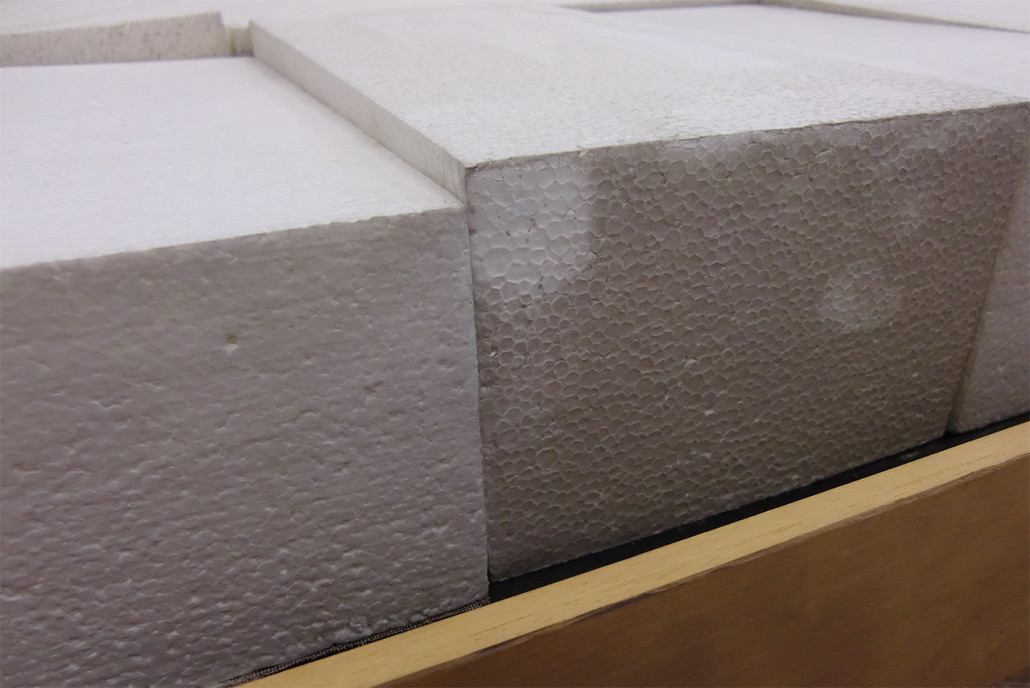
Gianni Colombo’s “Strutturazione pulsante” is a combination of polystyrene blocks, joined at the back by a system of small cords, and with an electro-mechanical animation that makes the external surface throb. A small electric motor transmits movement through two long strips of metal that the artist retrieved from an old rotisserie (spit-roast machine).
Maintenance and restoration work was carried out in 2011, 2012 and 2013.
In 2012, complete structural and aesthetic restoration work was carried out by the Zanolini and Ravenna restoration centre in agreement with the staff of the Colombo archives. The work involved the following operations: cleaning and removing small surface scratches, removing deposits of atmospheric particles and altered vinyl glue that caused yellowing on the surface, complete overhaul of electrical equipment and all elements (belts, wooden gears, springs, etc) essential for the artwork’s operation, fixing and replacing fabric gauze and small cords.
This artwork by Gabriele Devecchi consists of a white cube-shaped area in which projected light beams intersect each other, altering the perception of space. Viewers perceive changes of depth and size of the space and feel that the area has undefined perimeters. This is achieved by two slots on the right and left sides of the area, through which light beams are projected from small lamps that rotate on mechanical arms.
The work on display at the Museum of the Twentieth Century is a reissue made in 2005 of the original 1969 project. In 2011, the spotlights and bulbs were replaced, and in February 2012 the surface of the sliding mechanical arm, made of cardboard and adhesive tape as created by the artist, was removed and archived; it was replaced with a semi-transparent plastic film.
In November 2013, we noticed that the artwork was not operating properly due to wear on the cam which operates the mechanical arm. After dismantling the assembly and replacing the sliding surface to facilitate the mechanical arm’s movement, we proceeded to clean, lubricate and replace other components, while waiting to find a replacement for the deteriorated cam.
Gabriele Devecchi’s “URMNT 70” is a kinetic sculpture in the form of a square. It consists of a screen of black metal behind which a white PVC sheet is moved, from the back, by the pressure of a small mechanical arm that creates an optical illusion of motion and a continuous ripple effect. As for the other kinetic works, in this case too the artist used a small electric motor to rotate the mechanical arm.
The artwork’s state of conservation and operating efficiency was adequate following the latest check-up in 2013. The spongy end of the mechanical arm in contact with the PVC has left black marks on the surface, without actually tearing the plastic material. As part of a plan for scheduled maintenance, it would be advisable to obtain more PVC sheets to replace the current one, but this is not possible since the same product is no longer available. Therefore, we shall periodically replace the tape at the ends of the double mechanical arm so as to slow down the process of degradation.
Museo del Novecento
Piazza Duomo 8
Milano
www.museodelnovecento.org