
Drawings in the SOZZANI COLLECTION


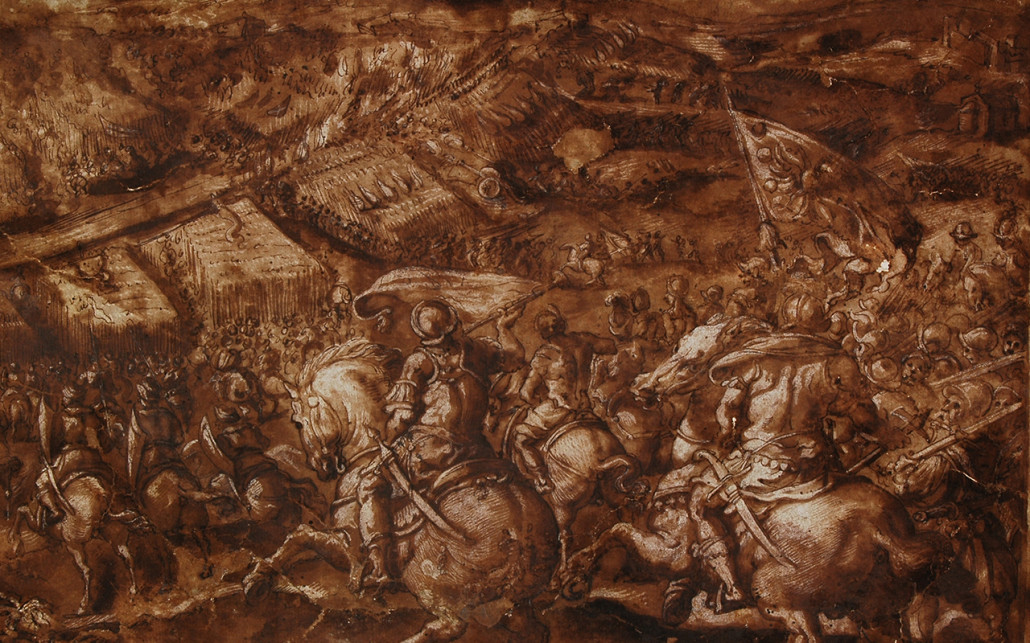
The restoration carried out on the drawings in the Sozzani Collection lasted about eighteen months, and was rather complicated because of the number of works, the variety of executive techniques, and the various types of damage found.
The results of restoring works on paper are rarely exciting in visual terms – the material’s porosity and absorption limit the restorer’s field of action; therefore, the damage even when restored is difficult to camouflage, always remaining visible.
So, in general, the main aim is to remove or slow down as much as possible the causes of deterioration, especially when external to the work. It involves operations of consolidation where more restoration is carried out on the front face of works than on the back and conducting actions of an aesthetic nature only if consistent with criteria of reversibility and clearly compatible with the drawing techniques in question.
In agreement with the management of the Diocesan Museum, priority was given to the conservation aspect of the works, taking action on the aesthetic side only if the work’s legibility was jeopardized.
The main problem with these drawings, but also in general for works on paper, was incorrect mountings in terms of systems and materials used.
First of all, restoration involved extracting the drawings from their original frames (which were restored by a restorer with specialised knowledge). Then it was necessary to remove the sheets from the old passe-partouts mostly made of paper and cardboard with high content of lignin, which is particularly harmful for conservation since it transfers oxidation and acidity to the paper with which it has contact, darkening and weakening the sheets.
After manual separation from the frames of the passe-partouts, followed by dry cleaning of the paper surfaces using white Wishab sponges, it was necessary to detach the sheets from the cardboard backing to which they were fixed, mostly by means of adhesive tape across the corners.
The damage caused by this adhesive tape was already evident when the drawings were still in their frames. There were brownish and very ugly rectangles around the pieces of adhesive tape used on the front of the paper. Apart from the aesthetic damage caused by the yellowing of the adhesive, there was also oxidation of the glue which weakened the paper and made it semi-transparent.
A drawing that was badly damaged was “St John the Apostle” by Jacopo da Chimenti, where pieces of adhesive tape were used not only for mounting but also to “repair” the torn and frayed edges of the sheet. The alteration had jeopardised the comprehension of the image (in particular the saint’s face) previously marked by many torn pieces and abrasions.
Removing the sticky tape and cleaning the stains on the back of the sheet made it possible to see the clear outline of the drawing. Other materials used previously for mounting (now removed) were strips of antique paper or gummed paper stuck onto the front, touching the edges of the work and the back of the window on the passe-partout.
After detaching the sheets from the external cardboard frames, normally stiffer, we found that most of them were reinforced by paper or sometimes cardboard supports, which in many cases were completely glued, while in a few cases only along the edges and the corners of the sheets. This backing was removed only where it was possible to intervene without putting at risk the drawing technique.
Different ways of removal were used, with the only criterion of working from the front – removing the support from the sheet and never the sheet from the support, to avoid creating tension and distortions. In some cases, we made minor discoveries of drawings on the front of the sheets or the backing, which had remained hidden for years. In many cases we decided not to remove the completely glued support. In fact, it would have been extremely risky to do so either because the paper was too thin and delicate (“Study of head” in “sanguigna” by Tuscan artist, mid-seventeenth century) or because the technique is too sensitive.
Most of the drawings made with metallic inks were completely glued to paper or card backing, probably due to their fragility. Attempting to detach them from the backing could cause tearing of the paper along the ink lines and the loss of fragments; for all these reasons, detachment was avoided.
Once free of their supports, the sheets were cleaned of glue residues and paper fragments from the backing, and paper patches or inserts from old restorations were removed.
The treatment of stains and discolouration caused by dampness and water was very limited, only in cases of real interference with the appearance, and as always only when compatible with the technique.
It’s worth mentioning the treatment of drawings that had areas of white lead. This lead-based white pigment was used to create what are known as “lumi”, that is, highlighting the parts of the composition that are well-lit.
The white lead was applied by brush and is very dense and opaque. In contact with air, it undergoes a chemical change, frequently turning black or dark brown. The problem is aesthetic, since the image that is formed is essentially negative. The collection contained only three works with white lead, and this type of alteration was clearly visible. We decided to intervene by applying diluted hydrogen peroxide only in the altered areas, to recreate the proper appearance.
Not many sheets had the characteristic alteration known as “foxing”, that is, the presence of reddish brown speckles resembling fox fur. This phenomenon is due in part to the oxidation of metal fragments in the paper mixture, in part to fungal attack, as well as a combination of both.
We decided to intervene only on a “Warrior’s head” by a Neapolitan artist, where the reddish spots overlapped and blended with the “sanguigna” lines of the same colour.
The treatment did not completely eliminate the foxing but lightened it so that it was less disturbing. For the sheets free of backing, we were able to go ahead with repairing torn pieces, reinforcing edges and frayed areas, by applying thin strips of tissue paper, and integrating the lacunae (including those caused by silver fish) using double-layer inserts with tissue paper or other paper chosen for its light weight and surface finish, according to the type and period of the paper to be integrated.
Special attention was reserved for sheets with metallic inks which were particularly fragile.
The corrosion caused by the acidity of the inks had resulted in weakening and tearing along the darker lines, with loss of fragments.
Most of the works using this technique had already been reinforced with cardboard backing which, as already mentioned, was not removed.
For those where the support was fixed only on the edges, it was necessary to intervene in order to prevent further loss of fragments.After cleaning the area and removing old patches, we had to apply a thin layer of tissue paper to strengthen the sheet and hold the torn areas together.
Before retouching the drawings, the sheets were flattened and smoothed under weights. So, after flattening and completely drying the sheets, we started the task of retouching done in different ways depending on whether we were working on the original paper or on paper inserts carried out during restoration.
In some cases the inserts were on pre-dyed card in subdued colours; these were retouched slightly with watercolours to link them to the colouring of the work. Or tissue paper was used, ivory colour with “tratteggio” in watercolours.
Retouching on the original paper was carried out, for reasons of reversibility, with pastel colours of the soft and chalky type. The intervention was necessary to cover superficial abrasions or to colour the clear patches resulting from cleaning the marks of adhesive tape with solvent – tape that had protected the area from oxidation.
For the one case of a drawing on prepared paper, retouching the missing colours (also on the original paper) was carried out using a mixture of powdered pastel combined with Klucel G, and diluted with alcohol so that it could be brushed on.
After completing the work, the drawings were mounted in the frames that the collector had chosen.
So, depending on the size of the drawing and the corresponding frame, the sheets were either mounted in a passe-partout made of conservation cardboard, or separated from the glass by means of spacers made of cardboard and protected in the same way from the cardboard passe-partout, made of pure cellulose without acid but with alkaline reserve.
Both systems were used to prevent the paper coming into contact with acidic materials and to avoid direct contact with the glass, forming a minimum air gap and thus obviating the problems of condensation on the sheets.
The original windows in the gallery have been replaced with special museum glass. In fact, collections of drawings would not normally be displayed permanently because the paper and the drawing techniques are highly sensitive to light and in particular ultraviolet rays. But given the request of the donor, namely that all the drawings should be displayed with their frames, it was necessary to find a solution that would allow display without endangering conservation. The museum glass used, besides having anti-glare characteristics making the works perfectly legible, have an anti-UV filter of 98% that significantly retards the damage caused by ultraviolet radiation.
In addition, the gallery staff have arranged special spotlights which are turned off when not needed, helping towards the preservation of these drawings as long as possible.
Text by Lucia Tarantola